The Amber Warning: 3 Trouble Codes Haunting Inland Empire Fords from Holt Boulevard to the I-10


When the dreaded yellow glow illuminates your Ford's cluster during an Inland Empire crawl, it's rarely a random glitch. Here are the three most frequent trouble codes hitting local Fords and how to tackle them.
Ontario, CA — It is 5:15 p.m. on an asphalt-melting August afternoon. Traffic on Interstate 10 westbound is backed up past Mountain Avenue, baking thousands of radiators, manifolds, and catalytic converters in waves of Inland Empire heat. That is usually when the amber glow strikes: an illuminated engine silhouette glaring from the instrument cluster of a high-mileage Ford Crown Victoria, a contractor’s F-150, or a retired Police Interceptor logging its second life.
For local drivers navigating San Bernardino County roads, a Check Engine Light (CEL) is often treated with shrugs or a piece of electrical tape. But under the hood of a Ford Modular 4.6L, 5.4L Triton, or modern EcoBoost, the onboard diagnostics system (OBD-II) is sounding an alarm that local technicians see day in and day out.
"Folks ignore that yellow light until they're parked on the shoulder of Euclid with coolant venting across the hood or raw fuel cooking their catalytic converters," warns a Mission Boulevard technician with decades of wrenching on local fleet vehicles. "By then, what started as a fifty-dollar sensor or cracked vacuum hose turns into an invoice that'll drain your savings."
Here are the three trouble codes most frequently burning through Inland Empire scan tools—and why Ford owners in Ontario cannot afford to ignore them.
P0171: System Running Lean (Bank 1)
One of the most persistent codes logged on Ford vehicles across the region is P0171, signaling that the engine’s powertrain control module (PCM) has detected too much oxygen—or insufficient fuel—in Bank 1. When an engine runs lean, internal temperatures soar, creating a dangerous combination under hot Southern California skies.
Common culprits behind the P0171 code include:
- PCV Hose Deterioration: The rubber elbow behind the intake manifold tends to soften, crack, and collapse under extreme engine bay heat.
- Contaminated Mass Air Flow (MAF) Sensors: Inland dust and fine desert sand blown down through the Cajon Pass frequently coat the heated wires of the MAF sensor, skewing airflow readings.
- Failing Fuel Delivery: Clogged fuel filters or tired fuel pumps struggling to keep up with highway demands.
- Intake Gasket Leaks: Hardened plastic intake manifolds and degraded gaskets drawing unmetered air directly into the combustion chamber.
Letting a lean condition ride can lead to spark knock, burned exhaust valves, and eventual catalytic converter destruction.
P0128: Coolant Temperature Below Thermostat Regulating Temperature
Many Ontario drivers assume cooling system codes only trip when a motor overheats on the climb up Cajon Pass. In reality, code P0128 frequently triggers during morning commutes when the engine fails to reach operating temperature in the computer's expected timeframe.
In Ford vehicles, this almost always points to a thermostat that has failed mechanically in the open position, or a degrading engine coolant temperature (ECT) sensor sending irrational voltage signals. While a cold-running engine might sound benign in the Inland heat, it prevents the vehicle from entering closed-loop fuel management. The PCM continues dumping rich fuel mixtures to warm things up, resulting in atrocious fuel mileage, fouled spark plugs, and excessive carbon buildup along the cylinder heads.
P0420: Catalyst System Efficiency Below Threshold (Bank 1)
In California, code P0420 is the code every motorist dreads. It indicates that the downstream oxygen sensor is detecting exhaust gas composition that mirrors the upstream sensor, meaning the catalytic converter on Bank 1 is no longer scrubbing emissions effectively.
Before panicking about the strict California Air Resources Board (CARB) replacement converter prices, vehicle owners need to understand that P0420 is frequently the victim of another crime. Extended driving with unresolved lean codes (like P0171) or intermittent ignition misfires will dump unburned hydrocarbons directly into the converter core, causing it to overheat and fail prematurely. In other cases, simple exhaust leaks near the Y-pipe or lazy downstream O2 sensors deceive the PCM into throwing the code.
Addressing the root cause early can preserve the converter and save drivers thousands of dollars when smog inspection time rolls around.
Don't Let an Amber Light Turn Into a Breakdown
Ignoring your dash warnings won't make the underlying fault disappear; it only guarantees a bigger repair bill down the line. Whether your fleet workhorse has developed a rough idle or your daily commuter just popped an unexpected light, our team has the diagnostic gear and Ford-specific experience to pinpoint the exact failure and get you back on the road.
Ready to get ahead of engine trouble? Schedule your diagnostic inspection with our Ontario service team today.
This story is brought to you by Crown Vic Guys — Ontario's specialists for Crown Victoria, Police Interceptor, and Ford fleet service.
Crown Vic Guys
Ontario's specialists for Crown Victoria, Police Interceptor, and Ford fleet service. Real wrenches. Real hands.

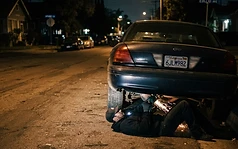
Catalytic Converter Thefts Surge Across the Inland Empire: Why Crown Victorias and Ford SUVs Are in the Crosshairs


Retired Ford Police Interceptor Utilities Are Flooding Ontario Used Car Lots — Here's What To Check Before You Buy