Meltdown on Mission: Why Inland Empire Ford Explorers Are Hitting Their Breaking Point

As triple-digit temperatures bake the Inland Empire, local Ford Explorers and Police Interceptors are struggling to keep their cool. We break down why your fleet is overheating and how to prevent a catastrophic engine failure.
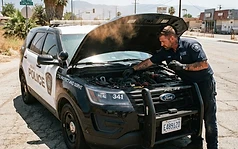
Ontario, CA — The mercury is climbing, and the asphalt on the 10 and the 15 is radiating enough heat to fry an egg. For the average commuter, it is just another brutal Inland Empire summer, but for the Ford Explorer and Police Interceptor fleet, it is a recipe for mechanical disaster. At Crown Vic Guys, our bays have been packed with cooling system casualties, and the trend is clear: when the desert heat hits, the cooling systems in these workhorses are the first to surrender. Whether you are running a patrol unit or a daily driver, the combination of stop-and-go traffic and extreme ambient temperatures is pushing these engines to their absolute limits. We are seeing a surge in radiator leaks, failing water pumps, and cooling fans that simply cannot keep up with the thermal load. It is not just a nuisance; it is a ticking time bomb for your engine block. ## The Heat Trap: Why Your Ford Is Struggling The Ford Explorer and its Police Interceptor variant are built for duty, but they are not immune to the laws of thermodynamics. When you are idling in gridlock near the Ontario airport or climbing the steep grades toward the Cajon Pass, your engine is generating massive amounts of heat while receiving minimal airflow. If your cooling system has even a minor restriction or a slightly aged thermostat, the system will fail to dissipate that heat effectively. Over time, the constant expansion and contraction from these heat cycles degrade hoses, gaskets, and plastic radiator tanks. Once a small leak develops, the system loses pressure, the boiling point of your coolant drops, and you are suddenly looking at a temperature gauge pinned in the red. ## Warning Signs You Cannot Ignore Ignoring a cooling system issue is the fastest way to turn a simple repair into a total engine replacement. You need to be proactive before the steam starts rolling out from under your hood. Keep an eye out for these common red flags: * Temperature gauge consistently reading higher than the midpoint during idle or heavy traffic. * A sweet, syrupy smell of coolant lingering around the front of the vehicle. * Visible puddles of coolant under the car after parking. * Cooling fans running at high speed constantly, even when the engine is not under load. * A sudden loss of cabin air conditioning performance while the engine temperature spikes. As one veteran Mission Boulevard technician put it, "When these units come in, they are usually screaming for help; if you see that needle creep up even a hair past normal, you are already on borrowed time before the head gasket gives out." ## Protecting Your Fleet The Inland Empire is a punishing environment for any vehicle, but with the right maintenance, you can keep your Ford on the road and out of the shop. Regular coolant flushes are non-negotiable, as old fluid loses its anti-corrosive properties and can lead to internal radiator blockages. Furthermore, inspecting your cooling fans and serpentine belt system during every oil change is the best insurance policy you have against a mid-summer breakdown. Do not wait for the warning light to flash on your dash. If your vehicle is showing signs of thermal stress, bring it by the shop for a comprehensive cooling system pressure test. We specialize in keeping these Ford platforms running reliably, no matter how high the temperature climbs. Visit our website at crownvicguys.com/book to schedule your inspection today and ensure your fleet stays cool under pressure. This story is brought to you by Crown Vic Guys — Ontario's specialists for Crown Victoria, Police Interceptor, and Ford fleet service.
Crown Vic Guys
Ontario's specialists for Crown Victoria, Police Interceptor, and Ford fleet service. Real wrenches. Real hands.