Buying A Retired 2018 Police Interceptor Utility: The Pre-Purchase Inspection Checklist
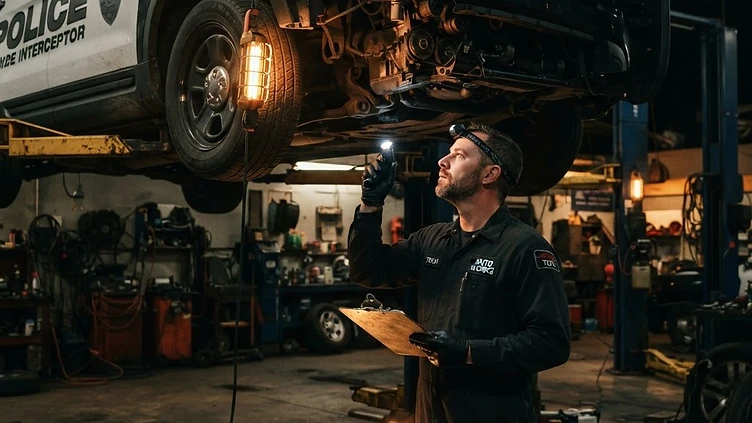
Mileage Lies. Engine Hours Don't.
A retired 2018 Ford Police Interceptor Utility can look like a steal: moderate mileage, heavy-duty everything, and a price that beats a comparable Explorer. But a civilian SUV with 60,000 miles and a patrol unit with 60,000 miles are not the same vehicle.
While idling, the odometer doesn't move — but the engine, water pump, cooling fans, alternator, and A/C compressor keep running. A PIU with 60k on the clock may have thousands of engine hours of patrol idle baked into it.
That's why a proper pre-purchase inspection matters more on these trucks than almost anything else you can buy.
Start With The Cluster
Before anything else, check the instrument cluster for:
- Total engine hours
- Idle hours (if displayed)
A common rule of thumb: heavy-idle patrol use can equate to roughly 30–40 miles of wear per idle hour. Use engine hours as a second odometer, not a footnote.
The Inspection Checklist
Have a qualified technician work through each of these before you buy:
- Scan every vehicle module for current and stored trouble codes — not just the PCM. Police electrical systems get modified, and faults hide in body modules.
- Check engine oil for coolant contamination. Pull the dipstick. Milky or light-colored oil is a red flag for internal water-pump failure on the 3.7L and 3.5L EcoBoost.
- Pressure-test the cooling system. A cold engine hides leaks a hot one reveals.
- Inspect the water-pump drain area. Coolant weeping here is the early warning before an internal failure.
- Verify actual oil pressure if any warning is present — with a mechanical gauge, not just the dash.
- Inspect the oil cooler and filter-adapter area for oil and coolant leaks.
- Examine the radiator, fans, hoses, and thermostat housing for leaks, residue, and damage.
- Inspect the PTU for leakage, burnt odor, bearing noise, and fluid condition. A grinding PTU is already too late.
- Test the purge valve and EVAP system — extended cranking after refueling is the tell.
- Test the A/C. Warm air at idle that improves while driving points to the compressor control solenoid, not necessarily low refrigerant.
- Review engine hours and idle hours against the odometer for consistency.
- Confirm all applicable recalls and service campaigns were completed.
What Service Records Reveal
Beyond the checklist, ask for:
- Fluid condition — coolant, oil, PTU fluid, transmission fluid. Burnt or contaminated fluids tell a story the seller won't.
- Cold-start behavior — rattles, smoke, or long cranking tell you about internal health.
- Maintenance history — a PIU with documented PTU services and coolant changes is a different animal than one with none.
Red Flags That Should End The Deal
- Milky oil or a rising oil level with no explanation
- Coolant loss the seller can't account for
- PTU grinding or binding on a test drive
- A/C that won't cool at idle
- No engine-hour data and no service records
The Payoff
A well-inspected retired PIU is one of the best values on the road — tough, capable, and cheap to buy. A poorly-inspected one is a fast track to an engine or AWD replacement.
The difference is the inspection. Spend the time (and a little money) up front and you'll know exactly what you're buying.
Want a professional set of eyes on a PIU you're considering? Bring it to us before you sign — book a pre-purchase inspection and we'll give you the full report.